Showing posts with label writing. Show all posts

March 23, 2016

A Comment on Comments

A couple of weeks ago, I went on a date with a man who was very hostile. He had asked me out without knowing anything about me, but by the time I arrived at the cafĂ© he had Googled me and decided he didn’t like me. I know this because he immediately began criticizing my opinion writing (he only believed in ‘facts’), my public profile (he is very ‘introverted’), and my social media use (he doesn’t even have a FB page).
He should have cancelled the date, but instead he arrived, barely looked at me, and then left after a cursory 29 minutes. I would not wish to repeat the experience.
Why am I telling you this? Because this, my friends, is why I don’t read the comments on my articles.
Reading the comments on the big websites I write for is like sitting down to coffee with someone who can’t stand me. They don’t know me, but they hate everything that I represent. I don’t want to subject myself to people who don’t like me, and so I choose to stay away.
Let me explain. Yes, there are some positive comments on big websites. But for the most part, people don’t comment a lot when they agree with an article. They might share it on their social media feeds, or press the ‘like’ button, or even message me about it, but they won’t bother logging in to the site and leaving a comment.
People log in and leave a comment most frequently when they are angry. And they are angry when they strongly disagree with the thesis of a piece. And when they strongly disagree with the thesis of a piece, they often decide the writer is a moron/an idiot/an *insert your choice of insult here*. Because angry people don’t see shades of grey. They see right and wrong, and if the writer is ‘wrong’, then they must be ‘bad’.
And so these commenters tell me how bad I am. They tell me how wrong I am. They tell me in all sorts of colourful language, with all sorts of capital letters, under all sorts of social media handles, most frequently anonymous. And they are allowed to do that, just like the dude I dated was allowed not to like me. But I didn’t have to date him, and I do not have to read the comments.
It doesn’t enrich me to read negative comments about my pieces. It frustrates me to read comments about me that are not true, and it frustrates me more that there is nothing I can do about it. And it depresses me no end to know that people like these commenters exist – people who are homophobic, anti-feminist, anti-choice, racist, or anti-whatever it is I have written about at the time.
Now, it’s true that there may be a useful comment in there somewhere. It’s true that someone may have a point of view that would enlighten or inform me. But sadly, I would have to wade through hundreds of insults to get to it, and the cost-benefit equation doesn’t add up in my favour.
When I stay away from comments, this frustration doesn’t exist. When I stay away from comments, these people don’t exist. And – whilst I know intellectually that they are still out there, just like the dude who didn’t like me still walks this earth – I don’t have to experience the frustration and sadness they bring to my life.
Happily, I still have this Facebook page, where people can leave a comment and communicate with me directly. For the most part, people are polite and friendly on my Facebook page, partly because they usually choose to visit my page if they already like my work, and partly because commenters are easily identifiable on Facebook. People are far ruder when they are shielded by anonymity than they are when you can see photos of their children.
But until such time as commenters are accountable on websites, I will continue to shield myself from their onslaughts. I am just a writer doing my job. And I would rather sit down for a coffee with someone who likes me than with someone who wants to tear me apart.

November 12, 2015

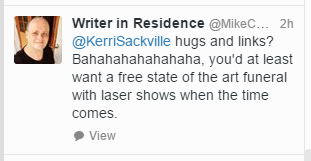
I was asked to write for free for a funeral planning site.... and this is what happened....

Firstly, the email and my responses:

Hi Kerri,
I am researching online for possible opportunities for my client to share content with within her industry.
Her new website is (redacted).
She has been in the funeral industry for a very long time and wanted to start a truly independent resource for people going through a funeral or a tragic loss. As counselling is a huge part of that I thought your site would be a great fit.
As you are a very successful writer I wondered if you would be willing to maybe write a blog post for her site?
I understand you may get a lot of these requests from agencies looking for links but we really are after quality content sharing with or without links. We believe if we provide quality and genuine helpful advice, people will link to it when they need to.
Would love the opportunity to chat further if you are interested.
Regards,
(name redacted)

Me: What are you able to pay?

Him: Hugs and great content.

Me: Seriously, help me out here as I just don't get it. You're asking a professional writer to write for free for a funeral planning site? 

Him: Yes, I wanted to offer you a chance for more exposure to your site also.

So I turned to Twitter to vent my frustration:

And the reaction was awesome:


Yup.


July 9, 2015

Keep Personal Correspondence Out Of The Public Arena - A Very Unpopular Argument

Yesterday I got into a discussion/debate with a number of commenters about a recent post in which a woman shared correspondence between her and a man she met on Tinder. The man wrote her a detailed email explaining that whilst he very much liked her, he wasn't attracted to her body because it was fat. The woman responded to him in her blog in an angry message explaining why he could kiss her arse.

I think (believe, know) the woman had every right to respond with whichever words she chose to the man in question. What alarms me is that she chose to do it publicly.

The woman is not alone. Recently Em Rusciano, a columnist I greatly admire and like personally, published a column about an awful man on Tinder who body shamed a potential date. Again, the correspondence was shared.

And Em is also not alone. This is a huge trend in social media at the moment. When people receive private correspondence that they do not like, or find hurtful or abusive, they share it online. And I'm not stupid. I understand the reasoning. There is an intense desire to shame the person involved, to expose them for the nasty piece of work they are. And there is an empowerment in shaming someone who has hurt you. It feels good to get it out in the open, and receive approbation and affirmation from countless strangers.

But that doesn't make it right. I don't believe it is okay to share personal correspondence online.

For one thing, we all make mistakes. We all hurt people. No, we are not all arseholes, but even arseholes are not arseholes all the time. If you feel it is okay to shame someone else, then you have to be prepared to be shamed yourself. And how would you feel if your own personal correspondence was shared? If you were nasty to a lover, or friend, in an unwise, unguarded moment, and they shared your text or email with the entire world?

And if you answer "I wouldn't care, because I wouldn't do that, and if I did I would deserve it," then ask yourself carefully: have you really never written anything of which you have been ashamed? Have you really never made fun of someone behind their back, or shot off an angry text, or been cruel? Have you really never done anything to which someone else could take offence?


And even if you answer no, think about this. Do we want a world where people jump online every time they are disgruntled? Where we no longer deal with personal issues between ourselves, but take them into the public arena for the world to referee? We try to teach our children to work through their differences without running to their parents or teachers, and yet what are we teaching them by racing to the internet every time when we have a dispute with another person?

If a person offends you, deal with them. Tell them how you feel. And if they continue to upset you, block them. Delete their messages. When you block someone they don't exist anymore. They are gone. It is a very powerful tool.

And obviously if they are threatening or harassing you, go to the police. Take out a restraining order. Threaten them with legal action. If a person is dangerous, you're certainly not going to protect yourself by shaming them publicly.

There are undoubtedly some situations in which disclosure is in the best interests of the public, for example when they involve authority figures or criminal activities or threats to public safety. But to have 'running to social media' as the default position for issues between two individuals creates all sorts of problems. We will become a society in which the morality is held externally, in the Greek chorus of the online world. And we will lose our personal resilience, to be able to deal with interpersonal difficulties without the assistance and intervention of a thousand strangers.

I know most people will disagree with me. But you can also rest assured that any personal correspondence sent to me will remain private. And I bet that even those who disagree with me will find that
reassuring.

July 6, 2015

THE TROLL EDITION

If there is one thing I don't want to be it's a hypocrite. I mean, there are lots of things I don't want to be. I don't want to be a leper, or a communist, or a parking officer, or a contestant on a reality show. But I also don't want to be a hypocrite. Not being a hypocrite is one of my Core Values.

And so, in giving with my Not Being A Hypocrit-ism, I must be prepared to be criticised. I make my living, in part, by writing opinion pieces, and if I am allowed to have my own opinions then other people must be allowed to have their opinions of me.

And here's the thing: not everyone will like what I write. Sometimes I write pieces that get floods of positive feedback, messages and emails and tweets and balloonagrams from the sky. (Okay, not balloonagrams, but we do like balloons here, so if you feel moved to send one, please contact me for my address.) But no matter how well received a piece is, there will always be someone who doesn't agree. No matter how much people love my writing, there will always be someone who thinks I'm shit. And no matter how many people love my work, there will always be someone who cannot stand the very sight of my name. (I must say, I'm included in that last one - I've always thought 'Kerri' was a pretty poor moniker.)

So if someone wants to express their dislike for my work, they should feel free to do so. Not that they need my permission, of course. But I'm giving it anyway (which will probably piss them right off). I genuinely, truly do not care if someone says I am a terrible writer, or that my opinions suck, or that my hair looks really bad now that it's been cut. (Oh GOD, I lie, I do care if you don't like my hair. Do you like my hair? Please tell me you like my hair!)

Obviously if someone is threatening, or brings up my family, or reveals intimate details of my life (it is MY decision when I tell you about my secret marriage to Simon Baker, NOT YOURS) I will come out fighting. But criticism, no matter how rudely expressed or laughably phrased, is absolutely fine.

So when Lana told me about some nasty comments about me on GOMI ("Get Off My Internets") recently, I was amused. We talk about it at length (well, five minutes is a length) in this video below. I also address those rumours about my divorce and my sex life with a female online personality. Exciting stuff indeed. Keep it going, GOMI!!!!!!

May 29, 2015

Do you want to truly SEE yourself? Try this.

A few days ago I had dinner with a girlfriend who is also a single mum. She's recently starting dating a new man, and when she described him to me alarm bells started ringing. I could read between the lines, I could sense her tension and uncertainty, it was so clear to me the way she was compromising.

I didn't say much. It's not my place to challenge her. But it got me thinking about the numerous times close friends of mine challenged me when I was dating someone who wasn't good for me. The guy was a million shades of wrong, and was making me far more miserable than happy, but I couldn't see it.

And why not? Because it is almost impossible to see ourselves objectively. We are too caught up in our own heads.

Many of us are tremendously emotionally intelligent about other people. We can deconstruct their spin. We can analyse their motivations. We can cut through their bullshit. We can give advice! Fabulous advice! We can show them the way forward!

But when it comes to helping ourselves out of a quagmire, we are completely stuck. We can't see our own patterns, because they are the veil through which we view ourselves. It's like discerning the Matrix when you're living in it.


You can't know what you can't even perceive.

Recently I discovered a trick to help me see myself the way I can see other people. I've found it to be incredibly useful during those times when I have found it difficult to be objective about my own situation, in regard to a relationship, my career, a parenting issue or a personal decision.

I write down how I feel, what has happened, what I need to decide. I write it down in detail, in the first person, for example:

I'm sure I did the wrong thing. I'm sure this is going to ruin everything. I spoke to her, and she told me it won't, and so far nothing has happened, but no-one can come back from a mistake like this.

And then I go through what I've written, give myself a new name, and change it all into the third person.

Amy was sure she had done the wrong thing. She was sure it was going to ruin everything. She spoke to Sarah, who told her it wasn't going to affect anything. And, so far, nothing had happened. But Amy was sure no-one could come back from a mistake like this.

Then I leave it. I file it away and ignore it for a day or two. And then I come back to it, and read it as though it really was the reflections of someone else.

And I can see it for what it is. I can see that Amy is worrying over nothing. Nothing has happened, she has been assured nothing will happen, and yet she is still worrying. Clearly, her anxiety is the issue and not the mistake.

Then I realise, Amy is me. And it is me who is worrying over nothing. It gives me the perspective I could not possibly have about myself. It gives me the emotional intelligence, the insights, that I can only have about other people.

Next time you're stuck, try it. And for my friend the single mum, I hope you try it too. I can see things that you can't, just like everyone could see things about me. Now we just have to learn to see them about ourselves.


March 19, 2015

Looking. Searching. Pining.

I have a problem.
I've become obsessed. And I mean obsessed. I've had obsessions before but this is different. I can't concentrate. I can't work. I can't focus on my kids. All I do is surf the web looking, searching, pining for the one.
And I can't find it. Or rather, I've found it about five times, but then I realise it's not right. It's not the one. It isn't satisfying me. There's another, that's right, that's perfect, that is going to solve everything. There's another, that is going to make everything okay.
And I can't stop.
It's been going on since Sunday. I have spent hours and hours and hours searching online for....
A desk.
A new desk.
A perfect new desk.
I hadn't even thought about a new desk before Sunday. I was happy with my (admittedly worn and a bit crappy) desk I bought when I first moved into my new apartment. I was rushing, at the time, and didn't put a lot of thought into it, but that's okay. It was fine. It served its purpose.
Until Sunday.
On Sunday I decided I needed a new desk. At first I wanted a super modern desk. Then I decided I needed a ladder desk. Then I was sure I wanted a secretaire desk, with a pull down front, and tiny little compartments. Then I was absolutely positive I wanted a super-cool vintage wooden desk, which unfortunately was only available in the States and couldn't be shipped to Oz.
Then I broke down, because it was hopeless. And then realised I didn't know what I wanted. I was just searching. I was searching for something. I was searching because I am lost.
I finished my manuscript on Sunday. My manuscript for my latest book. I sent it to my agent last November, and she recommended some revisions, which I worked on for the past four months. I worked hard. Really hard. Every single day I worked on my book. How I laugh when I hear of people writing novels in a month. This novel took a year of hard, all-encompassing work. And then I sent it in.
And now it's over.
And so I am searching, searching, searching for the perfect desk. Except that maybe I don't really need a new desk after all.
Maybe I just need to start a new book.
And it won't matter at all what I write it on.

January 4, 2015

When Your Writing Compromises Another

Yesterday I read ‘An Open Letter To My Ex-Wife’ on Huff Post. Apart from the fact that the writing itself was sappy, self-indulgent, and utterly manipulative (Have sympathy for me! My wife left me despite me loving her so, so much I wrote this beautiful love note! How awesome a husband must I have been to be so loving! And so brave, too, to rise from the devastation of the break-up and pen this letter!) it infuriated me that anyone – the man, the editors of Huff Post – could compromise another person’s privacy so fully.

These days, anyone with access to the internet can tell their life story, share every intimate detail of their interpersonal interactions with the entire world. And with such easy access to a readership comes a seeming lack of boundaries, a falling away of the moral codes which prevent us from sharing stories that compromise another person’s privacy and integrity.


I understand why the author of the Open Letter wished to communicate with his ex. I’ve written many emails to my ex partner, and him to me. But why an open letter? The recipient of an open letter is not the purported addressee, but rather the public. D’Ambrosio was not communicating with his ex; he was communicating directly with his readers. He was attempting to convey to the world what a wonderful, loving husband he was, presumably to garner sympathy and/or manipulate his ex into taking him back - or, more likely, to pull sympathy away from her and her decision. And it is not fair on his ex, who presumably did not consent to having his version of their joint narrative shared with the public. There is a line that exists between sharing one’s own stories and exploiting the other people in your life, and he crossed it.

And he’s not the only one. I am so dispirited by the myriad of pieces I read every day that ruthlessly and insensitively appropriate other people’s narratives. Mothers reveal their children’s deeply personal struggles, adult children write of their parents’ private lives, siblings write of old wrongdoings, without permission, without considering the extent to which it would compromise the other person.

Now, obviously our own narratives are shaped by our experiences in relation to the other people in our lives. Without sharing details of the way their lives impacted ours, we would have no stories. I am reading Dear Sugar’s brilliant book at the moment, and she writes of her husband’s infidelity (presumably with his consent) and her father’s abuse (presumably without). And in both cases, these stories are vital to the message she is conveying to the reader. In the first case, she is writing of the complexities of marriage, and how infidelity does not necessarily have to be a deal breaker. In the second, she is advising a girl who needs to cut off contact with her father, for reasons similar to her own.

Stories in contexts like these have meaning and purpose. They are not exploitive because they are fundamental to the story, and withhold the most personal of details. But when a story is there purely to titillate or garner hits, and it could compromise or embarrass the subject, then it is exploitation in its purest form.


Fiction writers often claim to write fiction to ‘tell the truth’, and that resonates strongly with me. If your writing could compromise other people in your life, then write it as fiction. Write it anonymously and change the names. Write it under your own name and change identifying details. And if you can’t do any of that, show some damn restraint. Just because you can do something, doesn’t mean you should. Writers need a moral code too. And readers don’t like to be party to someone else’s impropriety.

November 26, 2014

An Open Letter to Westfield about a Thrilling Proposal

Anyone who knows me will be aware that Westfield Bondi Junction is my spiritual home. I spend hours there, either doing the grocery shopping, grabbing a coffee, getting my acrylic nails repaired after I bite them off, or just wandering aimlessly, absorbing the seething humanity.

But there is something missing from Westfield. It's got the shops and the cafes and the movie theatre and the supermarkets and the high end boutiques and the people who stop you and try to rub hand cream on you even though you're carrying bags in both hands and walking quickly towards the exit.... But it doesn't have a cultural centre.

It doesn't have Culture.

And this is where I come in.  I can be Westfield's Writer in Residence. I can bring Culture to the mall. I could be set up at a desk on a little platform in the middle of the centre - perhaps surrounded by a small picket fence - and write away on my laptop. People can stop and watch as I write, marvel at the creative process, breathe in my literary energy. They can ask questions and I will answer them, inspiring and supporting other writers to stretch their wings and let the words fly. And I, in turn, can be energised and nourished by their presence (and get free Wifi and coffee, and the occasional chocolate snowball from the cafe on Level 2).


Of course, it's not just Westfield Bondi Juntion that needs Culture. Every Westfield could have its own Resident Cultural Person. Other Writers in Residence, or perhaps Artists in Residence, Musicians in Residence, even Interpretive Dancers in Residence (in fact, I could probably double as an Interpretive Dancer in Residence when the writer's block kicks in).

Westfield would benefit from the injection of art (and from the hoards of people flocking to see us in action), and we would benefit from being around those who inspire us - The People. (Also, there are much better sandwiches at the Food Hall than there are at home.)

If you agree, or are interested in applying for your own position at Westfield, please comment below, or hit Westfield up at @westfieldau. Support the cause! Bring art to your local mall! And make sure I get my egg mayo sandwiches every day!

November 17, 2014

So.... Last year I failed.

So. I have just finished writing my fourth book. I submitted it to my agent today. It is my first attempt at fiction. I enjoyed writing it. I just finished re-reading it and I was excited to find out what happened. Which was odd, because I knew. But I think it is a good sign.

Now, those of you who are familiar with my career might be scratching your heads. Hasn't she only written two books? When My Husband Does the Dishes and The Little Book of Anxiety?

Well, no. Those are the books that have been published. I wrote my third book last year. It is still sitting in my computer.

My third book was a memoir about grief. It was the story of my sister and I, intertwined with another painful episode in my life. The four publishers who saw it all said it was beautifully written. None of them would publish it. They said it was too sad and that they couldn't market a book about grief.

Getting that news was one of the lowest points of my life. Not the absolute lowest, obviously; I mean, hey, I've written a memoir about grief! I know what low moments look like! But it was pretty grim. I was fairly recently separated, and struggling to build a new life alone. I had taken a risk in writing a different kind of book, one which wasn't funny, or light, or easy to read. And I had taken time away from doing income-generating work, which was even more of an issue now that I was a single mum.

And I was used to success. My other two books were snapped up. I was always deeply grateful for my good fortune in being published, but I honestly never imagined that this third book wouldn't go the same way. I thought it would be a best seller. I thought it would soar. Instead I was told it wouldn't be published.

I was crushed. Crushed. I mean, temporarily broken. I sobbed non-stop for about thirty hours. I was beyond devastated. All that work, all that love, all that faith, gone to waste. It was a kick in the solar plexus. I was winded. I was inconsolable.

And then I finished crying, and I got up, and I got on with my life. And, once the dust had settled, I started another book.

I never mentioned my Grief Book (as I think of it) because I was ashamed. I was ashamed of the failure. But I'm not ashamed anymore. I'm not ashamed because I've picked myself up and tried again, and I'm happy with what I've written, and I'm hoping for good things.

And you know what? Maybe one day the Grief Book will be published. Maybe I'll self publish it and I'll sell a billion copies. Maybe I'll self publish it, and only one hundred people will read it, but out of those one hundred people, ten are deeply moved. I don't know. Life is long. There are many options ahead.

Keep trying, is what I'm saying. Keep pushing forward. You will have failures, you will have roadblocks, you will have bitter disappointments. But they fade, and you are left with the challenges and joys of today.

I hope my agent likes my new book. I hope it goes far. And if it doesn't, I will give it all up and get a job as a barista.

Or I'll write another book.

Yeah. Probably that.

September 11, 2014

Why Arianna Huffington is Wrong

Arianna Huffington is an impressive woman. She is an impressive woman who continues to make money from her website, the Huffington Post, which does not pay its bloggers. Though she has staff on the payroll, she does not pay the people whose blog posts appear on her site and generate page impressions and, therefore, income.

Last night at Carriageworks Annabel Crabb asked Ms Huff why she did not pay bloggers. She responded that she didn't need to. She believes that people want to write, and they will write anyway, and she offers them a platform - much like Tumblr or Facebook - on which to express themselves. They gain valuable exposure, which is payment enough. And besides, why should she pay them? They are willing to write for free!

She also (very cleverly) pointed out that Annabel's guests on her TV show are not paid. So that's pretty much the same thing, right?


Well, let's take that point by point.


  • The Huff Post is a platform, but it is not a site like Tumblr or Facebook. The latter are free-for-alls. Anyone can post, anyone can write. But the Huff Post is not a public platform. Only a select few get to write for the Huff Post. They are chosen specifically so that their words will earn income for the company. So the comparison is invalid.
  •  Yes, many people want to write. Many people enjoy expressing themselves creatively. And yes, as Ms Huff states, they will write anyway. But writing for yourself is like painting for yourself. It's lovely to express yourself in a painting or work of art. You can't expect to be paid for that. But if someone wishes to take your painting and hang it in their own environment, so that other people will be lured into that environment and spend money, they should damn well pay for it.
  • Not paying guests on a TV show is not the same thing as not paying a guest writer. A guest on a TV show is an interview subject, and it is anathema to journalism to pay for interviews. Whether or not Annabel pays her interviewees is utterly irrelevant. I can guarantee, however, that her producers pay the writers, the camera operators, the makeup artists, the directors, the lighting people, and everyone else involved in the making of the show. And that is the only appropriate comparison.
  • Underpayment or non-payment of particular professions is a serious problem from a feminist perspective. Traditionally, women have engaged in roles which are performed for love, rather than money. Teaching, nursing, social work etc have been underpaid for years because the people performing those roles - usually women - will do them anyway. This does not make it right. These people who are working in fields they are passionate about deserve payment as much as people working purely for money.
  • Yes, there are thousands of people willing to work for the Huff Post unpaid. They are willing to work unpaid because they feel they don't have a choice, because the systems in place - the systems maintained and perpetrated by the Huff Post, among others - give them no choice. And this is the very definition of exploitation: taking advantage of people who feel they have no choice.
Arianna Huffington is an impressive woman. But until she pays all her writers, she will not be the inspiration I am looking for.

August 7, 2014

Fuck Off - Why MC Had To Go

So Mike Carlton has been sacked resigned from his position at Fairfax.

I'm not going to comment on my feelings about that, though anyone who follows me on Twitter will know I did not exactly rent my clothes and tear my hair in lamentation.

I am aware that many of my fellow Fairfax columnists and other journos are dismayed at the precedent set by his sacking resignation. What goes on in correspondence between a columnist and a reader, they feel, should not bear any relevance to their work as a writer.

Well, I respectfully disagree.


I am a freelance writer, but write for Fairfax and other publications on a regular basis, and appear weekly on Channel 7. When I am interacting with people on social media, I represent myself, but I also, by proxy, represent the organisations that employ me.

These organisations choose to use my words and my image. They choose to use my 'brand'*. And so if my brand becomes something that they feel is discordant with their own brand, then I would expect my services to be terminated.

In other words, if I go around telling people to fuck off, if I go around hurling thinly veiled racial insults, if I am rude and disrespectful in my dealings with my readers, I would expect my brand to be compromised, and I would expect to make myself unemployable.

The thing is, every journalist and columnist in the world has experienced dissent and trolling. In the past month I've been accused of child bullying (because I criticized Bindi Irwin for telling girls how to dress), of being part of the Zionist Genocide Plot (because I expressed the view that posting images of dead children is disrespectful to grieving families), and of demonizing fathers (because I wrote a piece about a new campaign to highlight incest using Disney caricatures). Oh, and someone called me a zombie. I'm still not exactly sure why.

When I received these helpful pieces of feedback, there was just one thing I wanted to do. I wanted to tell those moronic correspondents to fuck the hell off.

But you know what? I didn't. Because a) it is isn't helpful, and it's not going to change their minds; b) I don't wish to lower myself to their level; and c) it's just rude. People are entitled to their opinions, even if those opinions are different to mine. And being rude to someone who is rude to me isn't going to help the situation one iota.

So in each and every case, I wrote the same message: "Thank you for your considered response to my opinion piece."

And if the person continued to abuse me, I used a very powerful little tool. I pressed 'block' and 'delete', and they were gone for my life.

I am far from perfect. I have allowed myself to engage in endless debates with people online when I really should have just exited quickly and stopped wasting my time. But I do try very hard to retain humour and courtesy. Because if we can't do that, then the horrible conflicts overseas that are not the responsibility of any person in this country are creeping into our own lives, and that would simply add to the tragedy.

*Yes, it's a wanky term, but you get my point..

March 11, 2014

It's Impossible. It's Intractable. What Is One To DO?

Here is the main problem with my life. It does not fit in with my circadian rhythms.

I am a Night Person, a Woman of the Dark. I function better in the evenings. I have never been a Morning Person - or if I was, it was so long ago that it has faded into the Eternal Night of my lost memories.

I do not jump out of bed perky and fresh in the mornings. I struggle into consciousness, blinking and foggy, and pull myself into a horizontal position by sheer force of will. I climb the stairs and check the kids are awake for school, and then drag myself to the fridge where I get out an orange and collapse again at the table to eat it*. If a child attempts to speak to me at this point, they will get a grunt. Perhaps a begrudging wave. I do not speak before I have had my coffee. At least not willingly. Or with any semblance of sense.

A problem of the ages (pun intended)

After my orange, I have my coffee, and then I am able to converse. But my brain doesn't warm up for at least another couple of hours. I can tidy and pay bills and maybe write a nice, light blog post, but I can't do any work of substance until later in the morning.

Sadly, though, it's when night falls that my powers of creativity really kick in. After eight, when the little one is asleep, and the big kids are watching TV and playing Minecraft doing homework, that's when it hits me. When the dishes are piled up on the sink and the school lunches are waiting to be made and there is a pile of laundry to be put in the machine... suddenly the genius idea strikes. I need to go to my computer and write.

And then I'm on fire. From eight until way after the kids go to bed, I am surfing the web and tweeting working like a demon. I feel energised and inspired. I could go all night.

Until it is midnight, and I realise I cannot see straight, and that I am never going to be able to get up in the morning. And then I fall into bed, and two minutes later the alarm goes off, and the whole maddening cycle begins again.

It's impossible. It's intractable. There is no solution.

Can anyone else relate at all? What is one to do?

*I always eat an orange first thing in the morning (see this old post, here)

March 4, 2014

My Secret Self-Help Tool

Let me tell you, I know therapy. I had therapy for years, and it did me a world of good. And I'm still very much into talking therapy, as my best friends will no doubt wearily confirm. (Also texting therapy, emailing therapy, Twitter Direct Messaging therapy, Facebook Private Messaging therapy....)

And I write journals. I've always written journals. In my early years I used to hand write them in tiny, lockable diaries. These days I type them directly onto my computer, and store them in double-password-protected files that no-one will ever be able to crack*. It's incredibly cathartic to write down your feelings and worries, as anybody who has ever committed thoughts to paper will know.

And catharsis is good. Catharsis is great. Catharsis stops us from putting our fist through walls and writing inappropriate things on social media. But to really make changes to our lives we need more than catharsis, and I've found a seriously effective way to use writing for self-help.


My Seriously Effective Way To Use Writing For Self-Help**

Think of a situation or issue in your life that is causing you difficulty. Perhaps you have a conflict with someone significant to you, and you can't figure out how to resolve it. Perhaps you're in a career or relationship rut, and don't know how to move forward. Perhaps you're making the same mistakes over and over, and you don't know why or how to stop. Or perhaps you have a really tough decision to make, and you can't choose one path or the other.

Write it down. Write it all out, in narrative form, from the very beginning, with as much detail as you have time to add. You know...

I've done it again. I've just had the discussion with John and he says he's not interested in getting married and having babies. I don't know how to convince him. I feel hopeless. I know he's the one I want to be with and he says he loves me but he can't commit....

Every day I wake up agonising about whether or not to take the job. On the one hand, it's a massive opportunity. And the money is fabulous. But on the other hand, I love where I am and I'm scared to make a bad decision...

Write it out. And then when you're finished, come back and do this magical thing:

Turn it into the third person. 

Give yourself a pseudonym, and then go through your narrative and rewrite it in the third person and in past tense, as if it happened to someone else. 

Tammy had done it again. She had the discussion with John and he said he wasn't interested in getting married and having babies. She didn't know how to convince him. She felt hopeless. She knew he was the one she wanted to be with and he said he loved her but he can't commit....

Every day Sue woke up agonising about whether or not to take the job. On the one hand, it was a massive opportunity. And the money was fabulous. But on the other hand, she loved where she was and she was scared to make a bad decision...

Don't re-read it just yet. Put it away for a while. Leave it alone. And then, a couple of days later, go back and read it over. You will be amazed at the difference it makes to read about yourself as if you were reading about someone else. It offers an entirely new perspective. Things become clear that were never evident before. We can be far more objective about other people than we can ourselves, and this tricks our minds into doing just that.

It works. I promise you. Try it and get back to me. 

Also, double passwords people. ALWAYS. Double passwords. 

*she says, praying
**if this was one of those shonky websites it would open onto a screen allowing you to see my Seriously Effective Way for three easy payments of $129

November 15, 2013

Regrets? I've Had A... Oops! They're Gone!

Since I've been able to wield a pen, I have kept diaries. They are excruciating to read. Dozens of little notebooks, smeared with blue ink, detailing every crush, every fight with a friend, every crush, every frustration, every crush, every dream, every crush, every act of rebellion, and did I mention every crush?


The most painful diaries to read are my Anne Frank style diaries, in which I gave the journal a name and wrote a letter to it every night. It was a notepad, for gods sake. I was writing to myself. I was twelve, but I still can't quite forgive myself for the pretention. I cringe even thinking about it. Please. Make. Me. STOP.

My sister also kept diaries. I was deeply respectful of her privacy, and would never, in a million years, have even considered trying to read one. She clearly didn't appreciate this, because she wrote in black texta on the first page of one such journal:

Kerri you are a bitch.

At least, I would have known this if I had ever picked up her diary and had a read. Which I didn't, of course. I was deeply respectful of her privacy. Ahem.

I still have my written diaries. They are stored in a sealed, plastic box in my storeroom, to be read after my death by anyone interested in a tormented, pretentious teenager with a tragic series of passionate, unrequited crushes.

By the mid nineties, I had become addicted to keyboards, and began writing my journals in electronic form. Thousands of words, committed to secret documents, locked by a password I still use today.

No-one will ever crack it. At least, so I pray.

The problem, of course, is that secret files are disposable. It is so much easier to hit 'delete' than it is to throw out a bound journal. It is so much easier to trash a file that brings back painful memories than it is to store it away in a sealed, plastic box.

And so I deleted dozens of files over the past twenty years. Dozens of files recording my life and my angst. Thousands of memories of good times and bad. Thousands of moments of anguish and joy.

I zapped my regrets with a press of a button. I zapped my regrets and I will never get them back. The words are now lost in the black of the Ethernet.

And that, I can tell you, is my greatest regret of all.

For those participating in next week's #MyFirst challenge (see here) the topic will be
My First Moment of Terror

October 10, 2013

Finished. The Truth About Being An Author

So I finished writing my latest book. I’m not sure how, because I can’t quite remember writing it. I know I sat down at the computer nearly every day for eight months and typed, but I can’t remember the words coming out. They sort of appeared on the page as if by magic, 65,000 of them, at the end of last month. I am hoping this is a sign that it is a work of genius, and not simply that I wrote most of it at night after a glass or two of wine.

I guess we’ll see.
 
There is a huge sense of satisfaction in finishing a manuscript, often compared to giving birth. Well, I’ve written three books, and given birth to three babies, and I can’t see many similarities at all. I mean, each time there was pain and a massive effort, and a lot of screaming for it to be over, but that’s where the comparison ends.

Creating a person from scratch takes nine months (or nine and a half, if you’re me). And then you push it out, and you have a new baby in your arms, and absolutely everything changes from that very first moment.
Finishing a book is completely different. Yes, this last book also took nine months, and yes, there was a definite high when I finished. I stared at the finished draft for several minutes feeling very clever, much like one would stare at a new baby. I had already decided what to name it, so I typed the name on it and closed the file. Then I treated myself to a cup of tea and a lie down, much as I did after giving birth, and rang my mum to tell her the good news. She was very excited, though not quite as excited as when I told her her grandchildren had been born.

Strange, I know.
But then that was it. Nothing else happened. I sent the file on to my agent, and that was the end of the story. Nothing changed. My life stayed exactly the same.

I have had two books published and this one will no doubt be published too. It’s a good book. I’m proud of it. But I know enough now to know that publishing a book isn’t the life changing experience one imagines it will be.
Becoming a published author is a crazy dream for so many of us. We imagine that everything will look different when we have achieved our goal. We will be successful, glamorous, perfectly fulfilled. But nothing much looks different. Sure, we have the excitement of seeing our book in print, and – if we’re lucky – the thrill of receiving royalty cheques in the mail. There may be a launch party, and some press. There may be minutes, even an hour or so, of glamour.

Essentially, however, life stays the same. Unless we are J K Rowling, or E L James, or Tom Wolfe, chances are we are not going to be propelled to super stardom. And we are not going to be propelled to great wealth.
But that’s not why we write. We write because we have to. Because we itch to be read. Because we cannot be happy doing anything else.

And for several minutes after we finish a manuscript, we feel very clever indeed.

August 4, 2013

It's Done

So I've finished the first draft of my third book. And if you've ever written a manuscript, painted a painting, composed a song, completed a PHD, renovated a house, or gestated a baby, you'll know how amazing that feels.

Writing a book is different for everyone. There are pantsers (as in, 'fly by the seat of their...'), who write as they go along, and plotters, who plan everything. And then there's me. I get a general idea of what I want to write about, start in a rush of enthusiasm, write 20 or 25 thousand words of a rough script with wild abandon, think "Oh my god, what I have I done", run out of steam for a bit, then pick it up again and labouriously, painstakingly, fill in the blanks.

There are times when it flows, beautifully. I can't stop writing; I resent having to get up from the computer to make dinner, do the laundry, or interact with other human beings (including my long suffering children). And there are times when it is hard, really, horribly hard, when the words don't come or a section just doesn't work and I have to force myself to get through it.

There are times I look at my word count and think, "GOD I've come far!", and other times I think "I am never, EVER going to finish this fucking thing." And inevitably, with every book, there is at least one moment when I decide the whole thing is utter crud and I have to throw it out and start again with a new idea.

But the key to finishing is this: I don't throw it out. I push on. And I finish.

Once the first draft is finished and I have my word count, then the fun begins. Because then I get to go back to the beginning and fiddle. And I love fiddling. It's just a question of fine tuning, putting a paragraph in there, taking a line out here, changing a word there, and making sure I don't use too many semi-colons. I'm addicted to them; I could use them in every sentence; they are awesome.

There is little more satisfying in life than finishing a big project. For me, it's writing books. For you, it may be something different. But if you haven't already, finish it. FINISH. Because even if this book is crap, even if no-one publishes it, even if someone publishes it and no-one buys it, even if someone publishes it and someone buys it but they give it a bad review.... no-one can ever take away the feeling of satisfaction I have right now.

And that is worth pushing on for.

(P.S. I'm not announcing the subject or title of my book until after it gets sold to a publisher. Which please god it will. Nothing will take away my satisfaction at completing it, but I damn well want to sell it, too!)

June 21, 2013

In Bad Form

Today I have to fill out forms.

I do not like forms. In fact, I am a little form phobic. I have a fear of forms, if you will. I don't give good form. I give bad form, even when I am in good form.

It is strange, because I like words. I like words very much. I use them all the time. They come out of my mouth, my fingers, my computer, my phone... I can throw them out all over the place with no effort at all. I can put words into a blog post, an article, a text, a tweet. No words phase me. I am at one with words.

Until I am required to put those words into a form. And then my heart clenches in fear and my body tenses with stress and I stare at the form and tap my foot on the floor and then go away to do something completely different because it is simply too scary.

It is a form. And forms are bad.

I tried to figure out why forms bother me so much. Theoretically, they should be far easier to complete than a thousand word article. You generally have to write only a word or two at a time, and there is no issue at all about spelling or grammar. And with online forms, you don't need to worry about making mistakes - you just return to the previous screen and do it again from scratch.

Tragic Woman Shown Not Actual Blogger

But then I realised. It's not the form of the form per se that disturbs me. It's the content of the form - or rather, the content that is not yet in the form, the content that I am required to put in the form. Because most of the time, I don't know the answers. Forms ask questions about dates and places and figures and events and obscure pieces of information that I do not know off the top of my head, nor am I able to find out without weeping for two hours in a dusty storeroom over piles of paperwork. Forms need me to think. They need me to calculate. They need me to look things up in filing cabinets. They need me to open up a bottle of gin and drink deeply until I am no longer afraid anymore.

But now I've written this blog post and I've cleaned the house. There is nothing left to do but go back to the form. Help me, people. Leave a comment so I can come back and respond. Ask me a question - the more complex the answer required, the better.

And if anyone lives in the Eastern Suburbs of Sydney and loves filling out forms, please come over. I will write you a thousand word thank you letter. Because I love words. Did I mention I love words?

June 5, 2013

Dear David, Thanks For The Feedback

So last night was an interesting one on Twitter.

I'd had a rough day, as happens on occasion. A couple of people had disappointed me, as people are wont to do. And I was feeling a little grumpy, as was fairly understandable.

And so I tweeted about it. I guess I wanted some support. And Twitter is fairly excellent for that.

I didn't write 'I am feeling really grumpy', because that is not my style. I try to be funny, and a little lighthearted, even when I'm feeling cross.

So I wrote:

Several people have annoyabled me this morning. I feel crankalily. Why is everyone so irritadedinglyish?

Well, a couple of people Tweeted back, which was welcome, and comforting. And then this came in, from one David Oldfield, of One Nation (and Pauline Hanson) fame.

I'm annoyed by loons who screw with the English language and think it's clever or funny - your tweet is neither!


Well, I can't pretend his comment didn't smart. I wouldn't have to pretend, because it genuinely didn't. I honestly don't care what one David Oldfield thinks of my writing. I mean, obviously I'd prefer it if the entire world found me hilarious, but statistically speaking, it's unlikely that would ever happen. And, given that someone has to find me neither clever nor funny, I would rather it be David than, say, the editor of the Sydney Morning Herald, or the publisher of my next book.

Still, the entire scenario fascinated me. Why on earth would someone - a grown man, a father of two sons, a husband, a political figure, and a radio host - want to attack a person they don't even know over something so utterly unimportant? To call a perfectly harmless writer-type person a 'loon'? Putting aside the fact that he is wrong (because language, after all, is something to be played with and enjoyed), what did he get out of it?

Now, possibly I am a loon. I am certainly a loon for giving David Oldfield even more attention by writing this post. But I do wonder at the psychology of it all. And I see similar scenarios played out over and over on the internet, and every time, I wonder WHY.

I have never understood random attacks on strangers. Obviously we all have differences of opinion, and that is normal and fine and to be totally encouraged. And if David had said that he didn't like my tweet, I would have accepted that. I still wouldn't have been sure why he felt the need to mention it, but it was his prerogative. But to call someone a 'loon' is just nasty.

Still, for every David Oldfield, there are hundreds of people who are kind and loyal and caring and fun. And dozens of them tweeted their support for me last night, leaving Mr O no doubt wondering what an earth he got himself into.

And despite David Oldfield making me even more crankalily than I already was, they filled my heart with gladnesses. And I found myself happyish once more.

PLEASE note: I don't want this to degenerate into nasty comments about David Oldfield. Just comments about the post, gorgeous readers. x

May 27, 2013

Ever Criticized A Blogger???

Yesterday, the Sunday Telegraph featured an article by gossip columnist Ros Reines, in which she slammed Mummy Bloggers in general and a few key players in particular, and shot an arrow at the burgeoning field of Daddy Bloggers, too.

Now, I support Ros's right to have an opinion. We all have opinions; I've certainly formed one about her column. What I object to is the mean-spiritedness which permeated her article.

The women and man mentioned in the piece are real people. They are real people with feelings and families and insecurities and hopes, and Ros tore them down quite knowingly with her words. Remember that these people aren't doing anything to hurt anyone; one is a broadcaster and writer, and the others are bloggers. None are vicious or cruel, in fact, the worst that Ros could accuse them of was being 'self-indulgent'. So why be so unkind?


Most forms of self-expression are 'self-indulgent' to an extent - writing, music, painting, dancing, they all are external depictions of an internal state. There is nothing wrong with this. It is life. It can be art.

If we don't like someone else's self-expression, then the sensible thing to do is to stay away. If you don't like someone's music, don't listen to it. It's simple. And if you don't like someone's blog, don't read it. Easy. There's no need to be mean. Just close the screen and be gone.

But by the same token, we as writers need to stop taking criticism so personally. Not everyone will like us, and that is okay. No writer (or musician, or artist, or dancer) can appeal to everyone. I cannot think of one piece of writing in the entire world that is universally loved - not Shakespeare, not Austen, not even Marian Keyes!!!! And if Shakespeare & Austen & Marian Keyes aren't universally loved, what chance on earth do I have?

My style of writing doesn't resonate with everyone, and I really am fine with that. I try to focus on the people who do enjoy my work, and forget about the ones who don't.

People, it is OKAY not to have universal appeal. I hope that you all remember that.

And Ros Reines, with the very deepest respect, I hope you can remember that too.

March 19, 2013

Managing Anxiety, Part One: Force

As many of you will know, last year I released The Little Book of Anxiety; Confessions from a Worried Life.   Since writing the book I have been toying with the idea of releasing an ebook entitled Beating Managing Anxiety; Advice From a Worried Person. However, I don't know the first thing about releasing an ebook, and besides, I don't want to charge anxious people for advice. We all deserve as much help as we can get, and I want to share what I know for free.
And so, without further ado, here is Part One of my new series. Parts Two to Until-I-Finish will follow shortly.

Let me tell you this one little secret - anxiety hates nothing more than company. Anxiety likes to live alone, dwelling in the fertile lush pastures of the empty mind. The very best weapon against anxiety is to keep busy. Anxiety needs to be driven out with force.

When I am anxious, my natural instinct is to fret. I become completely useless to myself and everyone else. I wander around in circles, I pace, I bite my nails. My heart races. My mind goes cloudy and I can't focus. If all I need to do is make the school lunches or write a blog post, I can't function. I can take an hour to put a sandwich together. I can sit at the computer and not make any sense.


Still, I've noticed something strange. If I am in this state and a producer from a radio station calls, and asks me to go on the air in five minutes, I will pull myself together. If an editor calls me and asks me to urgently write a piece, I will manage to do it. And for the entire time I am on task, I am focused and lucid and positive. I feel good. I feel strong. And when I finish the interview or column I feel better. It helps me to find my feet again.

Now, obviously I'm not advocating guest spots on the radio or calls from editors as the cure for all anxiety (but if radio producers or editors read this, please call me, I'm yours). What I am advocating, however, is that you find your own equivalent, something that works to get your mind off yourself and on the other. It is different for everyone, but we all have something, a task that will haul us out of our introspection and focus our attention elsewhere.

So what works for me? Well, my list is varied. It includes:
  • Doing radio or TV;
  • Doing any kind of public speaking;
  • Meeting a close friend for a coffee;
  • Writing to a deadline;
  • Attending a meeting, whether about my children or work;
  • Clearing out a cupboard or sorting through clothes;
  • Going for a walk with hip hop music blaring through my headphones. (It has to be hip hop. No other music calms me);
  • Organizing my handbag;
  • Browsing through online stores to choose something I need. (It doesn't work when I'm window shopping in real life - I can spend hours walking around Westfield in a haze of anxiety. But put me on the net and I immediately concentrate. All hail the online world.)  
Your list may be completely different. The key is to identify what works for you, write it down, and then turn to it when you're feeling anxious. 

Maybe you feel focused when you're cooking, or attending a spin class, or painting your nails. Maybe you are able to concentrate when you're planting tomatoes or running a seminar or drawing up a spreadsheet. Maybe you're about to become immersed in The Bold And The Beautiful or in the works of Dostoyevsky or in the Fifty Shades Trilogy. 

Whatever it is, use your strategies. When you are feeling anxious, pick one of your activities and do it. Keep busy and drive the anxiety out, even for a half hour or so. And the more respite you get, the stronger you will feel, and the easier it will be to drive it out in the long term.

Let me know how you go, and I'll see you for Part Two.

Like it? Share it!